
A recent report has raised an important question for website owners, publishers, forum administrators, and SEO professionals: could Google begin treating some AI-generated content as thin content?
The answer is more complicated than a simple yes or no.
Google has not announced a blanket penalty against content created with artificial intelligence. It has repeatedly said that the method used to create content is less important than the quality, accuracy, originality, and usefulness of the finished page. However, a recent manual action involving a long-established online forum suggests that large volumes of automated content may create serious problems when those contributions offer little original experience or added value.
The situation was initially reported by Search Engine Journal. The affected forum reportedly received a partial manual action for “thin content with little or no added value.” What made the case unusual was that the action targeted the forum’s active discussion section rather than older areas that appeared more obviously thin or outdated.
The forum also used an AI chatbot that had reportedly published more than 111,000 responses. Google did not specifically identify the chatbot as the cause of the manual action, but its activity quickly became the leading theory among SEO professionals reviewing the situation.
What Happened to the Forum?
According to the report, the forum received a manual action that affected its /threads/ directory. That section reportedly contained approximately 168,000 visible threads and more than half a million individual posts collected over roughly two decades.
The site owner was understandably surprised. The forum had existed for years, survived many major Google updates, and continued to receive organic traffic. The owner also stated that no example URLs were included with the manual-action notice, making it difficult to determine which specific pages or practices caused the problem.
The action was described as partial, meaning it applied to a defined section of the website rather than the entire domain. This is an important distinction. It suggests that Google’s human reviewer identified a problem with a particular group of pages instead of determining that the entire website was unworthy of appearing in search results.
A manual action is different from a normal algorithmic ranking decline. In a manual action, a human reviewer determines that pages violate Google’s policies or fail to meet required quality standards. The website owner must correct the problem and submit a reconsideration request through Google Search Console before the action may be removed.
Why Was the Site Owner Confused?
The forum reportedly contained two other sections that appeared to be more obvious examples of thin content: an old syndicated headline feed and an archived knowledge base. Both had been inactive for years, but neither was included in the manual action.
Instead, Google targeted the active forum directory.
That raised an obvious question: what was different about the forum discussions?
One possible answer was the presence of an AI chatbot presented as a staff member. The bot had been active since 2023 and had reportedly contributed more than 100,000 responses. Although no public statement from Google confirms that these automated replies caused the manual action, their scale and lack of authentic human experience made them a reasonable area of concern.
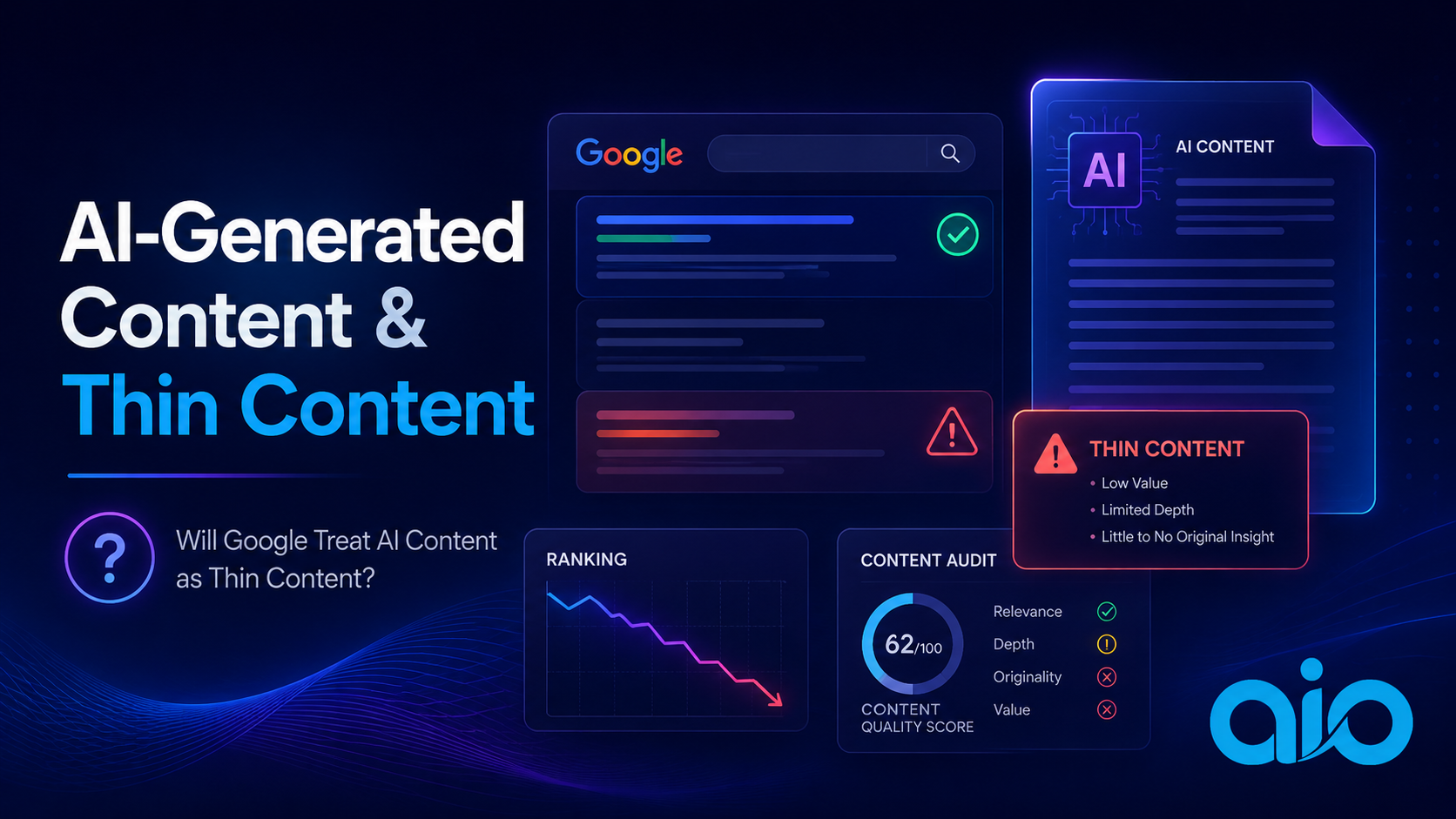
Does Google Penalize All AI-Generated Content?
No. Google’s published guidance does not say that all AI-generated content is prohibited or automatically considered low quality.
In its guidance on using generative AI content, Google explains that generative AI can be useful for researching subjects and adding structure to original material. The concern arises when automated tools are used to create large numbers of pages without providing meaningful value to users.
Google recommends focusing on:
- Accuracy
- Quality
- Relevance
- Originality
- Transparency
- A useful experience for the reader
The issue is therefore not simply whether AI participated in the writing process. The more important questions are:
- Why was the content created?
- Does it help the intended audience?
- Does it include original experience or analysis?
- Was it reviewed by someone who understands the subject?
- Does it add anything that cannot already be found elsewhere?
- Was it published primarily to gain search traffic at scale?
An article that uses AI during brainstorming but is researched, rewritten, verified, and improved by an experienced copywriter is very different from thousands of automatically published pages that receive little or no human oversight.
Why AI-Generated Forum Replies May Be Especially Risky
Forums have a unique purpose. People visit them because they want answers from other people who have experienced similar problems.
Someone visiting a repair forum may want to hear from a person who diagnosed the same mechanical issue. A software user may want a workaround from someone who encountered the same error. A homeowner may want to learn which solution worked for another homeowner in a similar situation.
The value of a useful forum response may come from:
- First-hand experience
- Original photographs or screenshots
- A detailed explanation of what worked
- A warning about an approach that failed
- A follow-up discussion with the original poster
- Knowledge developed through professional practice
- Details specific to an unusual situation
An AI chatbot does not personally repair computers, operate a business, visit a location, use a product, or experience a customer-service problem. It works with information produced elsewhere.
That does not mean an automated response can never be helpful. It may summarize documentation or point someone toward a possible solution. The problem occurs when that kind of second-hand summary is presented as a substitute for authentic community participation, especially across tens of thousands of discussions.
In that context, the content may be grammatically complete while still adding very little of the value visitors expect from a forum.
What Does Google Mean by Thin Content?
Thin content is often misunderstood as content with a low word count. That definition is far too narrow.
A short answer can be extremely valuable when it solves a problem directly. A 2,000-word article can still be thin if it repeats common information, avoids the real question, or provides no original insight.
Examples of potentially thin or low-value content include:
- Pages copied from another website
- Manufacturer descriptions reused without additional information
- Doorway pages created for slightly different keyword variations
- Location pages that only replace one city name with another
- Articles that rewrite competing search results
- Automated responses that repeat information already in a discussion
- Pages created without a clear audience or useful purpose
- Large numbers of pages published only because keywords have search volume
- Content produced without knowledgeable human review
Google’s people-first content guidance encourages publishers to ask whether their pages provide original information, complete explanations, insightful analysis, trustworthy sourcing, and meaningful value compared with other available results.
It also warns against publishing large volumes of automated material, summarizing other sources without adding value, and creating content primarily to attract search-engine visits.
Publishing at Scale Can Magnify Quality Problems
The scale of the forum’s AI participation is one of the most important parts of this story.
One imperfect automated response may have little effect on a large website. More than 100,000 automated replies can fundamentally change the quality and purpose of an entire section.
Large-scale automated publishing can produce problems such as:
- Repeated answers across different discussions
- Responses that misunderstand the original question
- Confident but inaccurate advice
- Generic language that adds no practical insight
- Artificially inflated activity within inactive threads
- Reduced visibility for genuine community members
- Thousands of low-value URLs competing for crawl resources
- A poor ratio of original content to derivative content
- Difficulty reviewing and correcting inaccurate statements
Google’s scaled content abuse policy applies when many pages are generated primarily to manipulate search rankings rather than help users. The policy can apply whether content is produced by AI, human writers, automation, or a combination of methods.
The technology used is not the deciding factor. The purpose, scale, originality, and value of the content matter more.
Should Website Owners Delete Old or Short Pages?
The forum case does not mean every short, old, or inactive page should be removed.
An older page may still:
- Answer a question people continue to ask
- Earn organic traffic
- Attract relevant backlinks
- Document a useful solution
- Provide important historical information
- Support another page through internal linking
Website owners should evaluate purpose and usefulness rather than age or word count alone.
Before removing a page, consider:
- Does it receive impressions or traffic?
- Does it have valuable incoming links?
- Does it answer a real customer question?
- Is the information still accurate?
- Could it be improved instead of deleted?
- Could it be consolidated with a stronger related page?
- Does it need to remain available without being indexed?
Depending on the answer, the appropriate action may be to update, expand, combine, redirect, noindex, archive, or remove the page.
How Businesses Should Use AI for Content
AI can be useful during content production, but it should support knowledgeable people rather than replace them entirely.
Begin With Real Business Knowledge
The best content reflects what a company actually knows. It should include real customer concerns, professional observations, service limitations, project examples, common mistakes, and lessons learned from practical experience.
Conduct Original Research
Review industry standards, official documentation, credible publications, product specifications, regulations, and relevant local information. Do not rely on the first summary produced by an automated writing tool.
Verify Every Important Claim
Automated systems can misstate facts, invent sources, confuse dates, or present outdated information confidently. Every statistic, legal statement, medical claim, technical recommendation, and product specification should be checked.
Add Examples and Specific Details
Original examples make content more useful and more difficult for competitors to duplicate. A detailed explanation of how a company solved a real problem usually provides more value than a generic list of tips.
Use Qualified Human Review
The reviewer should understand the topic well enough to identify inaccurate, misleading, or incomplete statements. Editing grammar is not the same as reviewing subject-matter accuracy.
Publish at a Manageable Pace
Businesses should publish as much content as they can properly research, review, and maintain. Ten excellent articles can provide more long-term value than hundreds of generic posts.
How to Audit Existing AI-Assisted Content
Companies that have already published substantial amounts of automated or AI-assisted content should conduct a quality audit.
Start by collecting URLs from:
- Google Search Console
- Your XML sitemap
- Your content-management system
- Google Analytics
- A website crawler
Then look for patterns such as:
- Pages receiving no impressions or visits
- Multiple articles targeting nearly identical searches
- Repeated introductions and conclusions
- Unsupported statistics
- Broken or fabricated citations
- Articles outside the company’s genuine area of expertise
- Content that simply restates competing pages
- Automated comments, answers, or forum posts
- Pages that have never received professional review
Low traffic alone does not prove a page lacks value. Some pages answer narrow questions that are important to a small number of highly qualified visitors. The audit should consider purpose, originality, accuracy, audience, and contribution to the overall website.
What Should You Do After Receiving a Manual Action?
A manual action should be taken seriously. Making a few superficial edits and immediately submitting a reconsideration request is unlikely to solve a widespread content-quality problem.
Google’s manual actions documentation explains that affected pages should be corrected before a reconsideration request is submitted.
A proper recovery process may include:
- Identifying the affected directories, templates, accounts, or publishing systems.
- Stopping the automation responsible for low-value content.
- Reviewing the full scope of affected pages.
- Removing or substantially rewriting weak material.
- Consolidating repetitive pages and discussions.
- Adding original expertise, evidence, and useful context.
- Correcting indexing, sitemap, canonical, and internal-linking issues.
- Documenting the steps taken to prevent the problem from returning.
- Submitting a detailed reconsideration request through Search Console.
The reconsideration request should clearly explain what caused the issue, what was changed, and what quality-control systems are now in place.
The Main Lesson for Website Owners
This story does not prove that Google considers every AI-generated article to be thin content. It does reinforce a broader principle: automation does not remove the responsibility to publish something worth reading.
AI can help with research organization, outlining, brainstorming, editing, and identifying missing topics. However, the final content still needs:
- A clear purpose
- Accurate information
- Original contribution
- Professional review
- Useful detail
- Knowledge of the intended audience
- A reason to exist beyond attracting search traffic
Businesses should treat AI as one tool within a larger editorial process. It should not become an unattended publishing department producing hundreds of pages without experience, judgment, or accountability.
The forum manual action may ultimately involve several factors, and only Google knows the reviewer’s complete reasoning. Still, the scale of automated replies and the lack of authentic first-hand experience provide a useful warning to any company publishing content in large volumes.
SEO Content Written by Real Copywriters
AIO Web Designs does not rely on unattended automation to create generic blog posts. Our SEO content is developed by real copywriters who research the business, its services, customers, competitors, terminology, and industry before preparing the article.
Each project includes background research designed to help the writer understand what matters to the company’s audience. We examine relevant search intent, common customer questions, industry sources, service details, and related topics so the finished article provides useful information instead of simply repeating what already appears online.
Our goal is to create well-written blog content that reflects the business behind it. Articles are organized for readability, optimized around relevant search topics, reviewed for quality, and written to support a broader website SEO strategy.
Whether your business needs educational articles, service-related content, local topics, customer resources, or an ongoing publishing plan, our copywriters can create researched content designed to improve topical relevance, build trust, and support long-term organic visibility.