Understanding SEO ranking factors is essential for any business that wants to become more visible in Google Search. Ranking factors are the signals and systems search engines use to decide which pages are most relevant, trustworthy, useful, and accessible for a particular search.
There is no single action that guarantees a first-page position. Google uses multiple automated ranking systems to evaluate content, links, website quality, search intent, location, usability, and many other signals. A page may perform well because it provides an excellent answer, has strong authority, loads efficiently, and is supported by a well-organized website.
This guide explains the most important SEO ranking factors and how they work together to improve organic visibility.
Helpful and Relevant Content
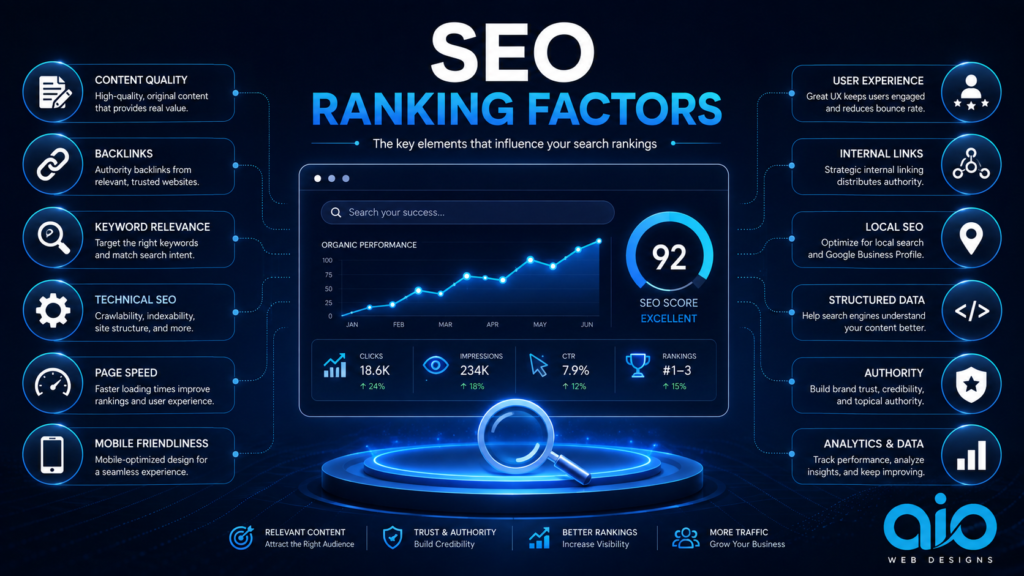
Content quality remains one of the most important SEO ranking factors. Google wants to provide results that satisfy the reason behind a search. A page should answer the visitor’s question clearly, provide useful detail, and remain focused on the topic promised by its title.
Strong SEO content generally includes:
- Accurate and useful information
- Original insight, examples, or analysis
- A clear answer to the user’s search intent
- Logical headings and organized sections
- Enough detail to explain the subject completely
- Natural language written for people rather than algorithms
Thin pages that repeat common information without adding value may struggle to compete. Businesses should create content based on real customer questions, service needs, buying concerns, and industry expertise.
Search Intent and Topical Relevance
Search intent describes what a person is trying to accomplish. Someone searching “what is local SEO” probably wants information, while someone searching “local SEO company near me” is more likely looking for a service provider.
Your page format and content should match that intent. A commercial service keyword usually needs a strong service page, while an informational keyword may be better served by an educational article.
Topical relevance also extends beyond using one exact keyword. Search engines evaluate related concepts, entities, subtopics, headings, links, and supporting pages. A complete website should build groups of related content around its primary services instead of creating isolated pages with no supporting context.
Page Titles, Headings, and On-Page SEO
On-page optimization helps visitors and search engines understand each page. Important keywords should appear naturally in prominent locations without being repeated excessively.
Key on-page elements include:
- A unique and descriptive meta title
- One clear H1 heading
- Helpful H2 and H3 subheadings
- A relevant URL
- A persuasive meta description
- Descriptive image alt text
- Contextual internal links
- Clear calls to action
The primary keyword should help define the page, but related phrases and natural variations are also important. Keyword stuffing can make content difficult to read and may weaken the overall quality of the page.
Website Authority and Backlinks
Backlinks are links from other websites to your content. Search engines can use these links to discover pages, understand relationships, and evaluate authority. A relevant link from a respected industry organization, publication, local association, or trusted business can be much more valuable than numerous low-quality links.
Effective link-building strategies include publishing original resources, earning media coverage, maintaining professional partnerships, contributing expert insight, creating useful tools, and developing content people genuinely want to reference.
Purchased links, automated link schemes, private networks, and irrelevant directory submissions can create unnecessary risk. The focus should be on earning credible links through strong content, relationships, and legitimate business activity.
Internal Linking and Website Structure
Internal links connect pages within your own website. They help search engines discover content and understand which pages are most important. They also help visitors move naturally from educational information to relevant services.
Every important page should receive at least one contextual internal link from another page. Anchor text should describe the destination rather than using vague phrases such as “click here.”
A strong website structure might connect:
- The homepage to primary service pages
- Service pages to related subservices
- Blog articles to relevant service pages
- Location pages to appropriate services
- Related articles to one another
Organized navigation and logical content categories also make the website easier to crawl and use.
Technical SEO and Indexability
A valuable page cannot rank if search engines cannot access, render, understand, or index it. Technical SEO creates the foundation that allows content to participate in search results.
Important technical SEO factors include:
- Indexable pages without accidental noindex tags
- Correct robots.txt directives
- Accurate canonical tags
- Working internal links
- Proper redirects
- An updated XML sitemap
- Secure HTTPS connections
- Mobile-compatible layouts
- Valid structured data where appropriate
- No serious server or rendering errors
Duplicate URLs, redirect chains, broken pages, incorrect canonicals, and JavaScript rendering problems can limit visibility even when the written content is strong.
Page Experience and Core Web Vitals
Page experience is another part of modern SEO. Visitors should be able to load, read, and interact with a page without frustration.
Core Web Vitals measure important aspects of loading performance, responsiveness, and visual stability. They should be treated as part of a broader user experience rather than the only technical goal.
Websites should also provide:
- Readable text on mobile devices
- Simple navigation
- Accessible buttons and forms
- Limited intrusive pop-ups
- Stable layouts that do not shift unexpectedly
- Clear separation between content and advertisements
A fast website cannot compensate for irrelevant content, but a poor experience may make it harder for an otherwise useful page to compete and convert visitors.
Experience, Expertise, Authority, and Trust
Google’s quality guidance frequently discusses experience, expertise, authoritativeness, and trust, commonly called E-E-A-T. These concepts are especially important when content could affect a person’s finances, health, safety, or major purchasing decisions.
Businesses can demonstrate credibility by including:
- Accurate company and contact information
- Clear author or reviewer information
- Real examples and first-hand experience
- Client testimonials and case studies
- Professional credentials where relevant
- Transparent service and privacy policies
- Reliable sources for factual claims
For additional information about how Google evaluates and ranks content, review the official Google Search ranking systems guide.
Freshness and Content Maintenance
Freshness matters most when users expect current information. News, pricing, laws, product specifications, schedules, and changing industry guidance may require frequent updates. Evergreen subjects may not need constant rewriting, but they should still be reviewed for outdated statements, broken links, and missing information.
Updating a publication date without making meaningful improvements is unlikely to create lasting value. Content updates should improve accuracy, usefulness, depth, organization, or relevance.
Local SEO Ranking Factors
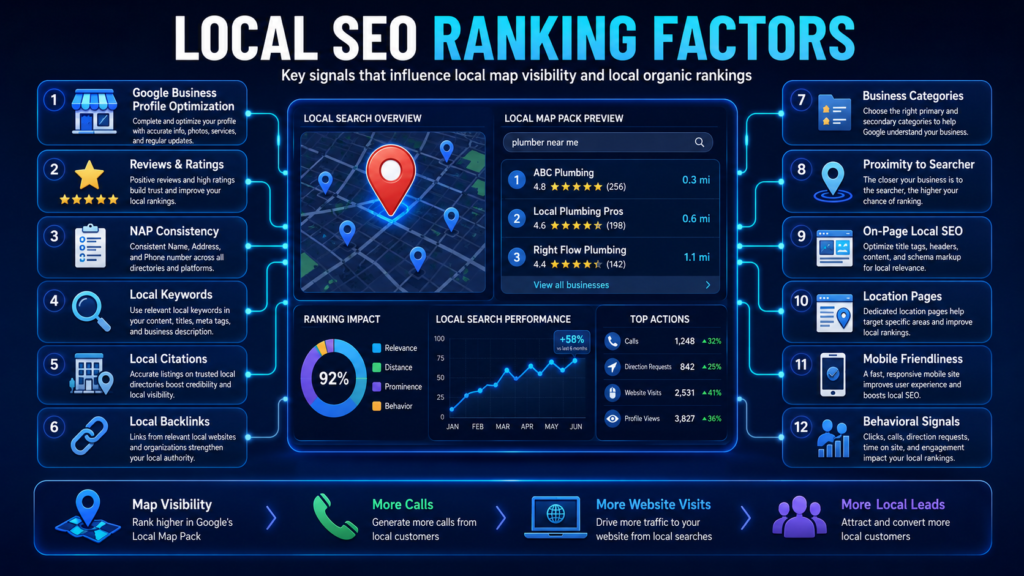
Businesses serving specific geographic areas should also focus on local SEO ranking factors. Local results are influenced by how relevant a business is to the search, its proximity to the searcher, and its overall prominence.
Important local signals include:
- An accurate Google Business Profile
- Appropriate primary and secondary categories
- Complete services, hours, and contact information
- Consistent business details across the web
- Genuine customer reviews
- Professional review responses
- Locally relevant website content
- Local citations and backlinks
Local SEO should connect the website, Google Business Profile, reputation, and service-area content into one consistent strategy.
User Engagement and Conversion Experience
SEO should not stop when a visitor reaches the website. A ranking is only valuable when the page helps the user take the next step.
Strong conversion elements include clear service explanations, trust signals, visible contact options, useful pricing guidance, responsive forms, and calls to action that match the visitor’s needs.
Google Analytics and Search Console can help identify pages receiving impressions and traffic but failing to generate engagement or conversions. These pages may need clearer messaging, stronger content, or a better user journey.
Spam Avoidance and Long-Term Quality
Attempts to manipulate rankings may create temporary movement but can damage long-term performance. Businesses should avoid copied content, hidden text, doorway pages, keyword stuffing, deceptive redirects, fabricated reviews, and link schemes.
Sustainable SEO is built through legitimate improvements that benefit users. Strong content, technical quality, authority, and a trustworthy business presence are more durable than shortcuts.
How Long Does SEO Take?
SEO takes time because search engines must discover, crawl, process, evaluate, and compare updated pages against competing results. New websites usually require more time to build authority, while established sites may see some improvements sooner.
Results can also depend on competition, website history, technical condition, content quality, backlink strength, location, and the amount of work completed. Some changes may be noticed within weeks, while meaningful growth for competitive keywords may take several months or longer.
SEO should therefore be measured through progress rather than one immediate ranking. Useful indicators include increased impressions, more ranking keywords, stronger average positions, additional organic traffic, improved engagement, and more qualified leads.
Improve Your SEO Ranking Factors With AIO Web Designs
Managing every SEO ranking factor requires ongoing research, technical work, content development, performance tracking, and strategic adjustments. AIO Web Designs helps businesses identify the issues limiting their visibility and prioritize the improvements most likely to support growth.
Our SEO services may include technical audits, keyword research, on-page optimization, internal linking, content creation, local SEO, Google Business Profile management, analytics, and in app ongoing reporting.
No agency can guarantee immediate rankings, but an organized professional strategy can reduce delays caused by technical mistakes, weak content, poor targeting, and inconsistent optimization. Working with AIO Web Designs may help your business implement improvements more efficiently and build search visibility faster than attempting disconnected SEO tasks without a clear plan.
Ready to improve your website’s search visibility? Contact AIO Web Designs to discuss an SEO strategy based on your website, market, competition, and business goals.